
PVC pipes are widely used in plumbing, drainage, irrigation, agriculture, construction, electrical installations, and industrial applications. Their durability, lightweight structure, corrosion resistance, and long service life make them suitable for many piping requirements.
A proper PVC Pipe Manufacturing Process involves several controlled stages, starting with raw material preparation and extrusion and continuing through sizing, cooling, cutting, inspection, and finishing. Each stage affects the final pipe's dimensional accuracy, surface quality, strength, and overall performance.
For manufacturers, understanding the complete PVC Pipe Production Process is important for maintaining consistent output and reducing production problems.
What Is PVC Pipe Manufacturing?
PVC pipe manufacturing is the process of converting PVC resin and other required additives into finished pipes with specific dimensions, wall thicknesses, and performance characteristics.
The basic process includes:
- Raw material preparation
- Mixing and compounding
- Extrusion
- Pipe sizing
- Cooling
- Haul-off
- Cutting
- End forming or belling
- Quality inspection
- Packaging and dispatch
Modern production lines use specialized machinery to maintain controlled temperature, pressure, speed, and dimensional accuracy throughout production.
1. Raw Material Preparation
The first stage of the PVC Pipe Manufacturing Process is preparing the raw materials. PVC resin is combined with additives according to the required pipe application and specifications.
Common additives may include:
- Stabilizers
- Lubricants
- Processing aids
- Impact modifiers
- Pigments
- Fillers
The formulation can vary depending on whether the pipe is intended for water supply, drainage, irrigation, electrical applications, or other industrial uses.
Proper material preparation helps maintain consistent processing characteristics and final product quality.
2. Mixing and Compounding
After selecting the required materials, they are accurately weighed and mixed.
The purpose of mixing is to distribute the PVC resin and additives uniformly throughout the material. Poor mixing can create inconsistent material properties and may affect pipe appearance and performance.
During the PVC Pipe Production Process, manufacturers need to maintain controlled mixing conditions to achieve a consistent compound before it enters the extrusion stage.
The prepared compound is then supplied to the extrusion line for further processing.
3. PVC Pipe Extrusion Process
The PVC Pipe Extrusion Process is one of the most important stages of pipe manufacturing.
The prepared PVC material enters an extruder through a hopper. Inside the extruder, rotating screws transport and process the material while controlled heat and mechanical energy help produce a uniform melt.
The processed PVC material is then pushed through a specially designed die.
The die determines the basic shape and outer profile of the pipe.
During this stage, manufacturers need to control several parameters, including:
- Extrusion temperature
- Screw speed
- Material feed rate
- Extrusion pressure
- Cooling conditions
- Production speed
Correct control of these parameters helps produce pipes with consistent dimensions and smooth surfaces.
4. Pipe Sizing and Calibration
After leaving the extrusion die, the hot pipe must be shaped and sized accurately.
The pipe passes through a sizing or calibration system that helps maintain the required outside diameter and dimensional specifications.
Vacuum sizing is commonly used to help control the pipe's shape and dimensions.
This stage is particularly important because variations in pipe diameter can create problems during installation and joining.
An effective PVC Pipe Manufacturing Process therefore requires accurate calibration and continuous monitoring of pipe dimensions.
5. Cooling the Pipe
Once the pipe is sized, it needs to be cooled so that it can retain its final shape.
The pipe generally passes through cooling tanks where controlled water cooling reduces its temperature.
Cooling needs to be properly managed. Excessive or uneven cooling can potentially affect dimensional stability, while insufficient cooling may make the pipe difficult to handle during subsequent stages.
The objective is to achieve stable dimensions before the pipe moves toward the haul-off and cutting sections.
6. Haul-Off and Pulling
After cooling, the pipe moves through the haul-off unit.
The haul-off system continuously pulls the pipe from the extrusion line at a controlled speed.
Maintaining consistent pulling speed is important because it can influence:
- Pipe dimensions
- Wall thickness
- Production speed
- Surface quality
- Overall consistency
If the pulling speed changes significantly, manufacturers may experience variations in pipe dimensions or thickness.
Therefore, synchronization between extrusion and haul-off equipment is an important part of efficient PVC Pipe Manufacturing.
7. Pipe Cutting
Once the pipe reaches the required length, it is cut into individual sections.
Automatic cutting systems can help maintain consistent pipe lengths while supporting continuous production.
Depending on the pipe specification and production setup, cutting systems may use different mechanisms to achieve clean and accurate cuts.
Proper cutting is especially important when pipes will later undergo socketing, belling, threading, or other end-forming operations.
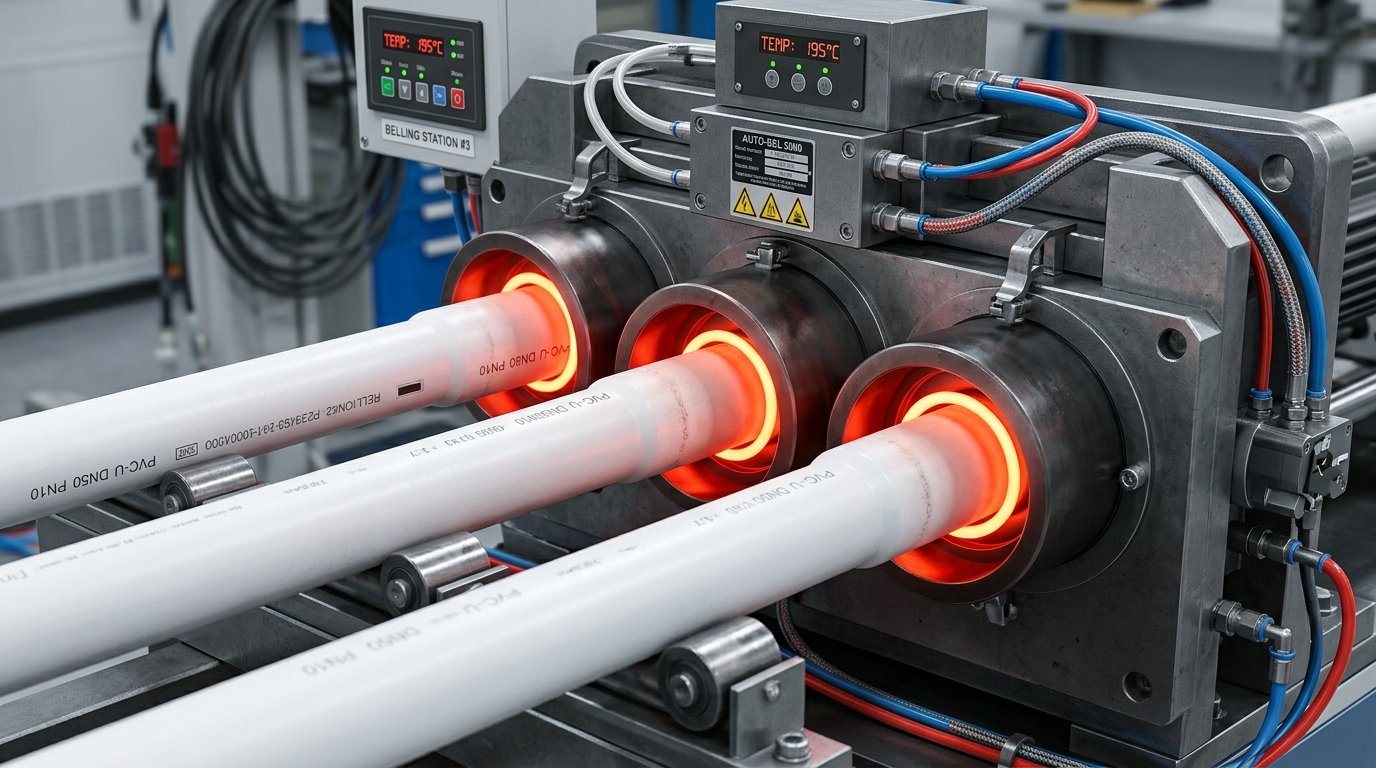
8. Pipe Belling and End Forming
For certain PVC pipe applications, the pipe ends need to be modified to create a socket or bell end.
This is where pipe belling machine or end-forming system becomes important.
The pipe end is heated to a controlled temperature and then formed into the required socket shape using appropriate tooling.
A properly formed socket allows pipes to be joined with compatible fittings or sealing systems.
The quality of this stage depends on factors such as:
- Heating temperature
- Heating time
- Forming pressure
- Tooling accuracy
- Cooling time
- Pipe dimensions
Accurate end forming helps create consistent joints and improves the usability of finished pipes.
9. Quality Inspection
Quality control is an essential part of the PVC Pipe Production Process.
Finished pipes are inspected to ensure that they meet the required specifications.
Manufacturers may check:
- Outer diameter
- Wall thickness
- Pipe length
- Surface appearance
- Weight
- Roundness
- Socket dimensions
- Joint compatibility
- Material consistency
Depending on the application and applicable standards, additional mechanical or performance testing may also be carried out.
Regular inspection helps manufacturers identify production variations before products reach customers.
10. Packaging and Storage
After inspection, finished pipes are prepared for packaging and storage.
Pipes should be handled carefully to prevent scratches, deformation, or other physical damage.
Proper storage conditions can also help protect pipes from unnecessary exposure to excessive heat, direct sunlight, or unsuitable handling conditions.
Once packed, finished pipes can be transported to distributors, construction projects, plumbing suppliers, infrastructure projects, or other customers.
Common Factors That Affect PVC Pipe Manufacturing
Several factors can influence the final quality of PVC pipes.
Material Quality
Inconsistent raw materials can affect processing stability and finished pipe performance.
Temperature Control
Incorrect processing temperature can cause surface defects, dimensional variation, or material degradation.
Extrusion Speed
The relationship between extrusion output and haul-off speed must remain properly controlled.
Cooling
Uneven cooling can influence dimensional stability.
Tooling Condition
Worn or improperly maintained dies and sizing components can affect pipe dimensions and surface quality.
Machine Maintenance
Regular maintenance helps keep production equipment operating consistently and reduces unexpected downtime.
How Modern Machinery Improves PVC Pipe Production
Modern machinery can help manufacturers achieve better control over production parameters and maintain consistent output.
Automation can assist with:
- Temperature monitoring
- Extrusion control
- Pipe sizing
- Cooling
- Cutting
- Production speed
- Material handling
- End forming
For manufacturers producing pipes at higher volumes, integrating reliable equipment can help improve production consistency while reducing avoidable manufacturing issues.
Neelkanth Microtech provides precision engineering solutions and machinery for plastic pipe manufacturing applications. For pipe-end processing, explore our PVC Pipe Belling Machine and PVC Pipe Socketing Machine. Its range includes equipment designed to support efficient pipe processing and end-forming requirements.
Why Understanding the Complete Process Matters
Understanding the complete PVC Pipe Manufacturing Process helps manufacturers identify where quality problems may originate.
For example, a dimensional issue may be related to extrusion conditions, calibration, cooling, or haul-off speed. Similarly, problems with pipe joints may be connected to cutting accuracy or end-forming parameters.
By monitoring each production stage, manufacturers can improve consistency, reduce material waste, and maintain better control over finished products.
The goal of an efficient PVC Pipe Manufacturing Process is not simply to produce pipes quickly. It is to produce pipes with consistent dimensions, reliable performance, and the quality required for their intended application.
Conclusion
The PVC Pipe Manufacturing Process is a continuous sequence of operations that begins with raw material preparation and continues through mixing, extrusion, sizing, cooling, haul-off, cutting, end forming, inspection, and packaging.
Among these stages, the PVC Pipe Extrusion Process plays a central role in determining pipe dimensions and production consistency. At the same time, accurate sizing, cooling, cutting, and end forming are essential for producing finished pipes suitable for installation and joining.
For manufacturers, combining proper process control with reliable machinery can support consistent production, better quality control, and improved operational efficiency.
If you are looking for precision machinery and engineering solutions for PVC pipe manufacturing applications, Neelkanth Microtech can help you explore suitable equipment based on your production requirements.
Need reliable machinery for your PVC pipe production setup? Contact Neelkanth Microtech today to discuss your machine requirements and production goals.
FAQs
1. What is the PVC Pipe Manufacturing Process?
The PVC Pipe Manufacturing Process involves preparing raw materials, mixing, extrusion, sizing, cooling, haul-off, cutting, end forming, quality inspection, and packaging.
2. What is the PVC Pipe Extrusion Process?
The PVC Pipe Extrusion Process converts prepared PVC material into a continuous pipe through an extruder and die. The pipe is then sized and cooled to achieve the required dimensions.
3. What are the main stages of PVC pipe production?
The major stages include raw material preparation, mixing, extrusion, calibration, cooling, haul-off, cutting, end forming, inspection, and packaging.
4. Why is temperature control important in PVC pipe manufacturing?
Temperature control helps maintain stable material processing and can affect pipe dimensions, surface quality, and overall production consistency.
5. What equipment is used for PVC pipe end forming?
PVC pipe end forming can be performed using specialized belling or socketing equipment that heats and forms the pipe end into the required shape.
6. How can manufacturers improve PVC pipe production efficiency?
Manufacturers can improve efficiency through proper process control, reliable machinery, preventive maintenance, automation, accurate material handling, and regular quality inspection.