
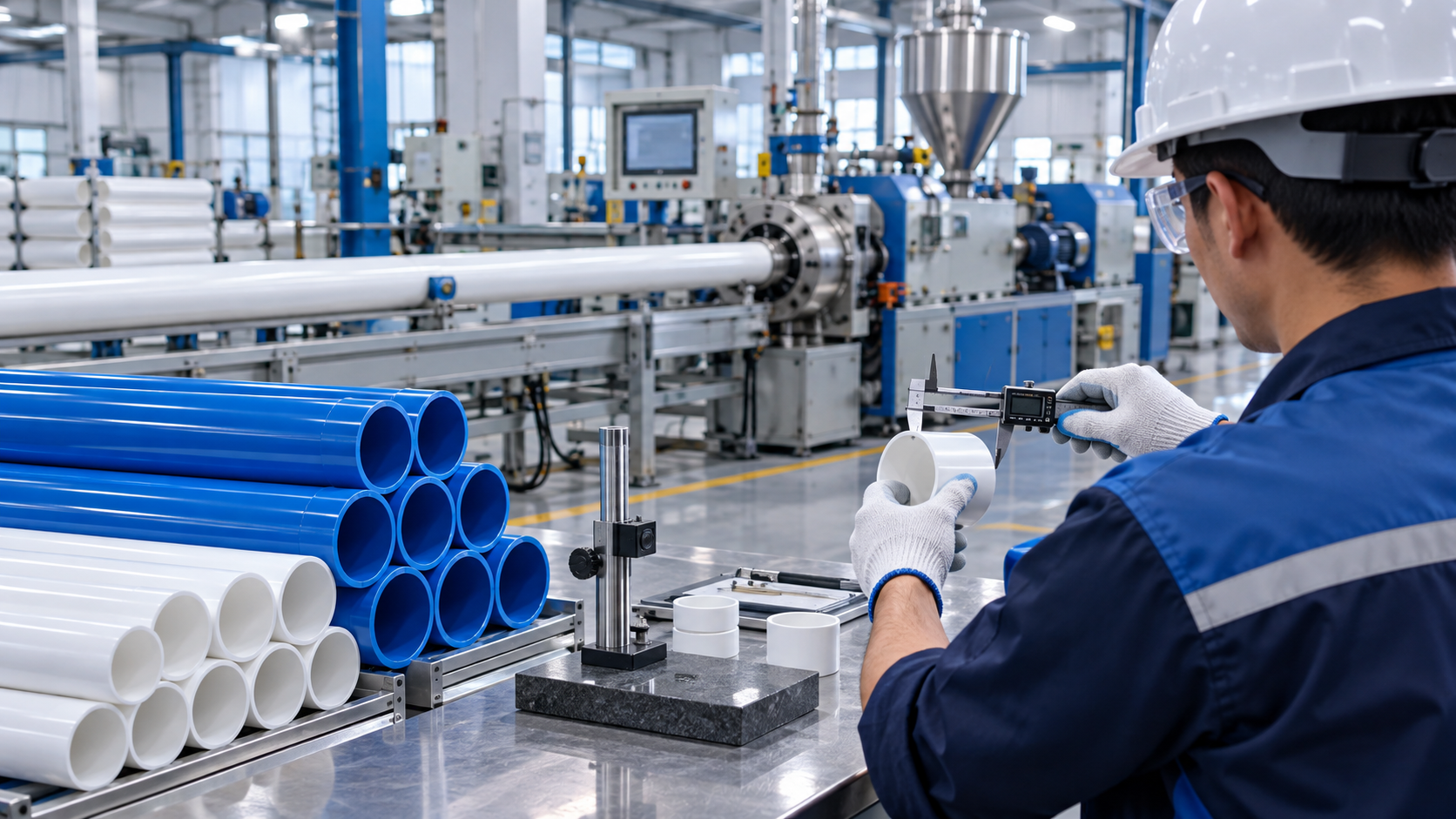
PVC pipes are widely used in plumbing, drainage, irrigation, water supply, and industrial applications. Their performance depends on consistent dimensions, suitable material properties, reliable joints, and proper manufacturing practices. For pipe manufacturers, maintaining product quality while controlling production costs is essential for long-term business growth.
Improving PVC Pipe Production Quality requires more than selecting good raw materials. Manufacturers must also control extrusion parameters, maintain machinery, monitor cooling conditions, inspect finished pipes, and identify defects before they lead to excessive waste.
Common PVC Pipe Manufacturing Problems, such as uneven wall thickness, surface defects, diameter variations, and poor pipe strength, can affect product performance and increase production costs. A structured approach to quality control helps manufacturers identify the causes of these issues and improve overall PVC Pipe Efficiency.
In this guide, we explain practical ways to improve PVC pipe quality, reduce manufacturing issues, and maintain consistent production.
1. Understand the PVC Pipe Manufacturing Process
The first step toward improving product quality is understanding every stage of the manufacturing process. PVC pipes are generally produced through extrusion, where the prepared PVC compound passes through an extruder and a die to form a continuous pipe.
The main stages include:
- Raw material preparation: PVC resin and suitable additives are mixed according to the required pipe formulation.
- Material feeding: The prepared compound is supplied to the extrusion machine.
- Extrusion: The material is processed and shaped into a pipe through a specially designed die.
- Sizing and calibration: The pipe is brought to the required diameter and dimensions.
- Cooling: Controlled cooling helps the pipe retain its shape and dimensional stability.
- Haul-off: The pipe is pulled through the production line at a controlled speed.
- Cutting: The continuous pipe is cut into specified lengths.
- Inspection and finishing: The finished pipes are checked for dimensions, appearance, and relevant performance requirements.
Each stage affects the final product. For example, inconsistent feeding can cause output fluctuations, while poor cooling control can result in dimensional changes or pipe deformation.
Monitoring the entire process makes it easier to identify where quality problems originate instead of relying only on final product inspection.
2. Use Consistent Raw Materials and Proper Mixing
Raw material quality plays an important role in PVC pipe manufacturing. Variations in resin properties, stabilizers, lubricants, processing aids, and other formulation components can affect the material's processing behaviour and final performance.
To maintain consistent production quality, manufacturers should:
- Purchase raw materials from reliable suppliers.
- Verify material specifications before production.
- Follow an approved formulation for each pipe grade.
- Measure additives accurately during mixing.
- Maintain consistent mixing time and conditions.
- Prevent contamination from dust, foreign particles, or unsuitable reprocessed material.
- Keep records of material batches and production results.
Improper mixing can cause inconsistent material distribution, resulting in variations in colour, surface finish, or mechanical properties.
Manufacturers should also avoid changing the formulation without proper evaluation. Any adjustment should be tested against the required product specifications to ensure that the finished pipe continues to meet its intended application requirements.
3. Control Extrusion Temperature and Processing Parameters
Temperature control is one of the most important factors in PVC pipe manufacturing. PVC requires suitable processing conditions to achieve adequate fusion without excessive thermal degradation.
If the processing temperature is too low, the material may not fuse properly. If temperatures or residence times are excessive, the material may degrade, resulting in discoloration, black spots, or other defects.
To improve PVC Pipe Production Quality, manufacturers should:
- Monitor barrel and die temperatures regularly.
- Check temperature sensors and heating systems.
- Maintain suitable screw speed and material feed rates.
- Monitor extrusion pressure and output consistency.
- Follow the recommended processing window for the specific formulation.
- Record machine settings when producing acceptable batches.
Avoid making several adjustments simultaneously when a defect appears. Instead, identify the likely cause, change one relevant parameter at a time, and evaluate the result.
Stable processing conditions improve repeatability, reduce unnecessary material waste, and support consistent pipe dimensions and surface quality.
4. Identify and Reduce Common PVC Pipe Manufacturing Problems
Understanding common defects helps production teams take corrective action before large quantities of material are affected.
Uneven Wall Thickness
Uneven wall thickness can result from incorrect die or mandrel alignment, inconsistent material flow, or unstable processing conditions.
How to reduce it:
- Check die and mandrel centring.
- Inspect the wall thickness at multiple points around the pipe circumference.
- Monitor extrusion pressure and material output.
- Verify that the tooling is clean and correctly installed.
Maintaining uniform wall thickness is important because excessive variation can affect pipe strength and increase material consumption.
Diameter Variation
Pipes may become oversized or undersized when calibration, cooling, or haul-off conditions are inconsistent.
How to reduce it:
- Verify the calibration system and sizing sleeve.
- Check vacuum and cooling conditions where applicable.
- Maintain a consistent haul-off speed.
- Measure the pipe diameter at defined intervals.
- Inspect the calibration equipment for wear or damage.
Early detection helps prevent entire production batches from falling outside the required dimensional tolerances.
Rough Surface Finish
A rough inner or outer surface may be associated with unsuitable processing conditions, inadequate material fusion, die contamination, or tooling damage.
How to reduce it:
- Inspect and clean die surfaces.
- Verify the temperature profile and material formulation.
- Check for material buildup inside the die.
- Review screw speed and extrusion output.
- Follow the equipment manufacturer's maintenance instructions.
Surface defects should be investigated carefully because different causes can produce similar visible symptoms.
Discoloration and Black Spots
Yellowing, brown marks, or black particles may indicate material degradation, contamination, or residue accumulating inside processing equipment.
How to reduce it:
- Check temperature settings and residence time.
- Inspect the material for contamination.
- Clean the die and other relevant components when required.
- Verify the formulation and additive distribution.
- Follow an appropriate purging and shutdown procedure.
Corrective actions should address the actual source rather than simply changing the colour formulation.
Pipe Bending or Deformation
Pipe deformation can occur when cooling is uneven or the pipe is handled before it has stabilized sufficiently.
How to reduce it:
- Maintain uniform cooling conditions.
- Check the alignment of downstream equipment.
- Avoid excessive haul-off tension.
- Support pipes correctly during handling and storage.
- Allow sufficient stabilization before stacking or packaging.
Systematic troubleshooting can reduce scrap and help maintain reliable product performance.
5. Maintain Proper Cooling and Calibration
Cooling and calibration have a direct influence on the dimensions and shape of extruded PVC pipes. After the material leaves the die, the production line must stabilize the pipe without introducing excessive stress or deformation.
Poorly controlled cooling may cause diameter variations, ovality, bending, or dimensional instability.
Manufacturers can improve this stage by maintaining consistent cooling-water conditions, checking the calibration system, inspecting spray arrangements, and verifying that the pipe travels through the line without unnecessary movement.
The vacuum calibration system, where used, should also be checked for suitable operating conditions and leaks.
Regular measurement of pipe diameter, ovality, and wall thickness helps identify changes before they become significant. The appropriate cooling settings will depend on pipe size, material formulation, production speed, and equipment design.
6. Implement Effective PVC Pipe Quality Control
A consistent PVC Pipe Quality Control system helps manufacturers identify defects, maintain product specifications, and improve customer confidence.
Quality checks should be conducted throughout production rather than only after the pipes are finished.
Important quality control activities include:
- Dimensional inspection: Measure outside diameter, wall thickness, length, and other specified dimensions.
- Visual inspection: Check for cracks, rough surfaces, discoloration, black spots, and visible deformation.
- Weight monitoring: Compare pipe weight against the approved product specification to identify process variation.
- Mechanical testing: Conduct the applicable impact, tensile, or other required tests according to the product standard.
- Pressure testing: Where applicable, verify performance against the relevant pressure and testing requirements.
- Joint inspection: Check bell or socket dimensions and joining characteristics when the pipe design requires socketed ends.
- Batch documentation: Record inspection results, raw material batches, machine settings, and corrective actions.
The tests required will depend on the pipe type, intended use, and applicable standards. For example, pressure pipes may require different performance checks from non-pressure drainage pipes.
Manufacturers should define acceptance criteria before production begins and ensure that inspection equipment is calibrated. Consistent records also help teams trace recurring problems to specific material batches, machine settings, or production shifts.
7. Improve PVC Pipe Efficiency Through Preventive Maintenance
Machine condition directly affects product consistency and production output. Worn components, faulty temperature sensors, damaged dies, and unstable downstream equipment can lead to recurring defects.
A preventive maintenance schedule helps reduce unexpected downtime and supports better PVC Pipe Efficiency.
Recommended maintenance practices include:
- Inspecting extrusion screws and barrels according to the maintenance schedule.
- Checking dies, mandrels, and calibration sleeves for wear.
- Verifying the accuracy of temperature sensors and control systems.
- Inspecting cooling pumps, water lines, and vacuum systems.
- Checking haul-off belts, cutting equipment, and alignment.
- Lubricating moving components where required.
- Maintaining records of servicing, repairs, and replaced parts.
Operators should also be trained to recognize early warning signs, such as unusual noise, fluctuating pressure, inconsistent output, or repeated surface defects.
Preventive maintenance is generally more effective than waiting for a breakdown or quality failure before taking action.
8. Standardize Production Procedures and Train Operators
Even with suitable machinery, inconsistent operating practices can create quality problems. Different operators may use different settings or respond differently to the same defect.
Standard operating procedures help ensure that production activities follow a consistent method.
These procedures should cover machine startup, temperature stabilization, material feeding, parameter adjustments, quality inspection, shutdown, and cleaning.
Operators should understand the relationship between processing settings and product defects. For example, increasing line speed without reviewing cooling capacity may affect dimensional stability. Similarly, changing temperature settings without checking material behaviour may create additional problems.
Regular training, clear inspection checklists, and documented troubleshooting procedures help teams respond to issues more consistently.
Manufacturers should also review production data to identify recurring defects, material waste, downtime, and output fluctuations. Tracking these indicators makes it easier to prioritize improvements based on actual production performance.
9. Monitor Production Data and Continuously Improve
Improving PVC Pipe Production Quality is an ongoing process. Manufacturers should regularly evaluate quality records and compare production results against defined targets.
Useful indicators include defect rate, rejected pipe quantity, material wastage, downtime, dimensional variation, and production output.
When a problem occurs repeatedly, conduct a root-cause analysis rather than relying on temporary adjustments. Compare successful and unsuccessful production batches, review machine records, and verify whether the corrective action prevents the defect from returning.
For example, if wall thickness variation occurs frequently, reviewing die alignment, material output, haul-off speed, and measurement records can help narrow down the possible causes.
Small, documented improvements can lead to more stable production, less rework, and better use of raw materials over time.
Importance of PVC Pipe Belling in Pipe Manufacturing
Maintaining consistent pipe-end dimensions is an important part of PVC pipe production quality. A PVC Pipe Belling Machine helps manufacturers form uniform bell ends, supporting proper pipe fitting and reliable joint connections. Accurate belling also helps maintain consistency during the pipe finishing stage and reduces variations in socket dimensions.
How Neelkanth Microtech Supports PVC Pipe Manufacturing
Neelkanth Microtech provides industrial machinery solutions for PVC pipe manufacturing and processing applications. Selecting suitable equipment, maintaining consistent operating conditions, and following proper quality control practices can help manufacturers improve production consistency and reduce manufacturing issues.
For manufacturers looking to improve pipe-end forming operations, a suitable PVC Pipe Belling Machine can support accurate bell formation and consistent pipe joining. Choosing equipment according to pipe dimensions, production capacity, and application requirements is an important part of building a reliable manufacturing process.
Businesses can explore suitable machinery options and discuss their technical requirements to identify an appropriate solution for their production setup.
Conclusion
Improving PVC pipe quality requires coordinated control of raw materials, extrusion conditions, calibration, cooling, equipment maintenance, and inspection procedures. Manufacturers that identify defects early and investigate their root causes can reduce avoidable waste and maintain more consistent product performance.
By strengthening PVC Pipe Quality Control, addressing common PVC Pipe Manufacturing Problems, and monitoring key production parameters, manufacturers can improve overall PVC Pipe Efficiency and create a more reliable manufacturing process.
A systematic approach to production quality helps ensure that finished pipes meet the dimensional, visual, and performance requirements of their intended applications. Regular monitoring, operator training, preventive maintenance, and continuous improvement are essential for maintaining these results over the long term.
Frequently Asked Questions (FAQs)
1. How can you improve PVC pipe production quality?
PVC pipe production quality can be improved by using consistent raw materials, maintaining suitable extrusion temperatures, controlling cooling conditions, monitoring pipe dimensions, and performing regular quality inspections. Preventive maintenance and operator training also help reduce manufacturing defects.
2. What are the common PVC pipe manufacturing problems?
Common PVC pipe manufacturing problems include uneven wall thickness, diameter variations, rough surfaces, discoloration, black spots, pipe deformation, and inconsistent socket dimensions. These problems can result from raw material variations, incorrect processing parameters, poor cooling, or equipment maintenance issues.
3. How does PVC pipe quality control improve product reliability?
PVC pipe quality control helps manufacturers identify defects during production and verify that finished pipes meet the required specifications. Dimensional measurements, visual inspections, and applicable mechanical or pressure tests help maintain consistent product quality.
4. How can manufacturers improve PVC pipe efficiency?
Manufacturers can improve PVC pipe efficiency by reducing material waste, maintaining stable extrusion conditions, optimizing production settings, scheduling preventive maintenance, and minimizing machine downtime. Monitoring production data also helps identify recurring problems and improve workflow.
5. What causes uneven wall thickness in PVC pipes?
Uneven wall thickness can be caused by incorrect die or mandrel alignment, inconsistent material flow, unstable extrusion conditions, or variations in haul-off speed. Checking tooling alignment and monitoring production parameters can help identify the underlying cause.
6. Why do PVC pipes develop rough surfaces or black spots?
Rough surfaces may result from unsuitable processing conditions, inadequate material fusion, or contaminated tooling. Black spots can indicate material contamination or degraded PVC residue inside processing equipment. The actual cause should be identified before adjusting machine settings.
7. How can PVC pipe manufacturers reduce production waste?
Manufacturers can reduce production waste by inspecting raw materials, monitoring dimensions during production, maintaining equipment, identifying defects early, and documenting corrective actions. Consistent process control helps prevent repeated defects and unnecessary rejected products.
8. What is the role of a PVC Pipe Belling Machine in pipe manufacturing?
A PVC Pipe Belling Machine forms one end of a PVC pipe into a bell or socket profile for joining. Proper heating, forming, and cooling help maintain consistent socket dimensions and support reliable pipe connections.
9. Why is preventive maintenance important in PVC pipe manufacturing?
Preventive maintenance helps identify worn components, faulty sensors, damaged tooling, and other equipment issues before they cause production interruptions or quality defects. Regular inspections can improve machine reliability and support consistent production.
10. How often should PVC pipes undergo quality inspection?
Inspection frequency depends on the pipe type, applicable standards, production volume, and the manufacturer's quality plan. Manufacturers should monitor important dimensions during production and conduct the required tests at defined intervals to verify that products meet specifications.